Central Asia's week that was #81
Purge in Kyrgyzstan, Tajik drone strikes on smugglers, Turkmenistan’s eco woes. Also, Uzbekistan clean air raids, U.S. sanctions Tashkent IT firm, and Kazakh football team-buying spree continues.

So this happened…

Authorities in Kyrgyzstan detained nearly a dozen opposition figures one week before parliamentary elections, accusing them of plotting to foment mass unrest. Those held included Kadyrbek Atambayev, the son of former president Almazbek Atambayev, and Temirlan Sultanbekov, a co-leader of the Social Democrats party. The case hinges largely on covertly filmed footage in which Sultanbekov, during a kitchen-table conversation, appears to endorse the prospect of “a change of power” after being repeatedly steered in that direction by an unidentified interlocutor. In a handwritten letter from detention, the younger Atambayev insisted “we have never called for unrest” and accused investigators of fabricating key elements of the case. Police claim the group intended to stage coordinated protests following the upcoming vote. The sweep fits a broader pattern of escalating political control under President Sadyr Japarov, whose rise in 2020 marked the start of a steady constriction of public space.
Tajikistan’s security services said they used a domestically produced drone to kill smugglers crossing from neighbouring Afghanistan in what appears to be the first use of such equipment in an operation. Officials said border troops intercepted seven men entering the Hamadoni district, a stretch of Tajik territory opposite Afghanistan’s far eastern Badakhshan region. At least two of them were killed. Fully 116 packages of narcotics were recovered after the strike, although officials did not specify the contents. Recent United Nations Office on Drugs and Crime data point to an increasingly volatile trafficking landscape: opium seizures across Central Asia collapsed after a Taliban-imposed cultivation ban, then surged again this year, even as the ban formally remains in force. At the same time, synthetic drugs and Afghan-made methamphetamine now account for a growing share of interdictions, with Tajikistan registering sharp increases in early 2025. Local media say Tajik border forces have engaged in at least 10 armed clashes with traffickers over the past six months.
Researchers at UCLA reported that Turkmenistan continues to account for most of the world’s worst methane-emitting oil and gas sites this year. Drawing on data compiled by Carbon Mapper, a non-profit that processes satellite imaging, the California-based university’s Stop Methane project found that 17 of the 25 largest detected hourly emitters were in Turkmenistan. Several sites in Esenguly district in western Turkmenistan’s Balkan province topped the list. Some plumes measured at around 10 tons of methane per hour. The findings jar with Ashgabat’s narrative of improvement. Last year, the government boasted of having cut methane emissions by around 10 percent relative to 2020 levels. It presented that claim alongside new 2030 reduction targets adopted after sustained pressure from international partners, with John Kerry, then the U.S. special envoy for climate, playing a central role.

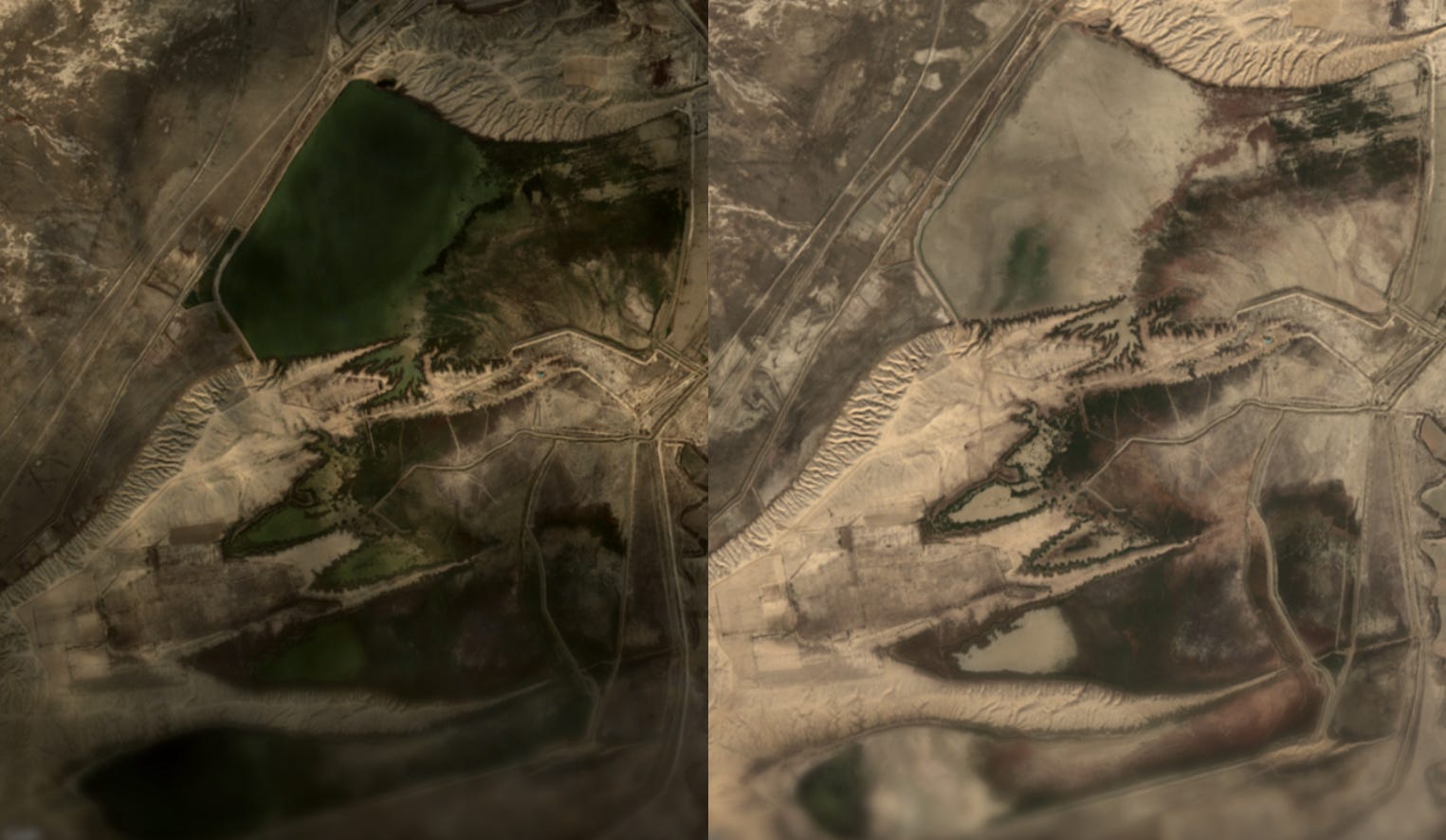
Satellite images of Turkmenistan’s Mammetköl reservoir showing its condition in November 2024 (left) and November 2025 (right), illustrating the complete dry-out recorded this year. Two reservoirs in western Turkmenistan have fully dried up, according to satellite analysis published by Meteozhurnal, a specialist meteorological outlet. Mammetköl and Delili, small reservoirs in Balkan province fed by the low-water Atrak river, shrank steadily over the past year and had no remaining water by early summer. Meteozhurnal based its findings on time-series imagery and precipitation data from the Etrek station, which recorded near-zero rainfall through 2025. The episode is modest in scale but an alarming signal for a region in deepening hydrological stress. Neighbouring Iran is now confronting severe shortages, with some reservoirs supplying Tehran reportedly near collapse. Turkmenistan faces a longer-term threat as Afghanistan’s Qosh Tepa Canal prepares to divert up to a third of the Amu Darya river’s flow, on which it heavily depends.